
What Am I Looking At?


Lately, we've spent our fair share of time in doctors' offices looking at different brain scans taken for Rob. The question, "What am I looking at?" comes up every time. The doctors all start by helping us understand the orientation of the scan and identifying regions of the brain, so we can understand what we are seeing. Taking that time is always beneficial and helps us all get on the same page.
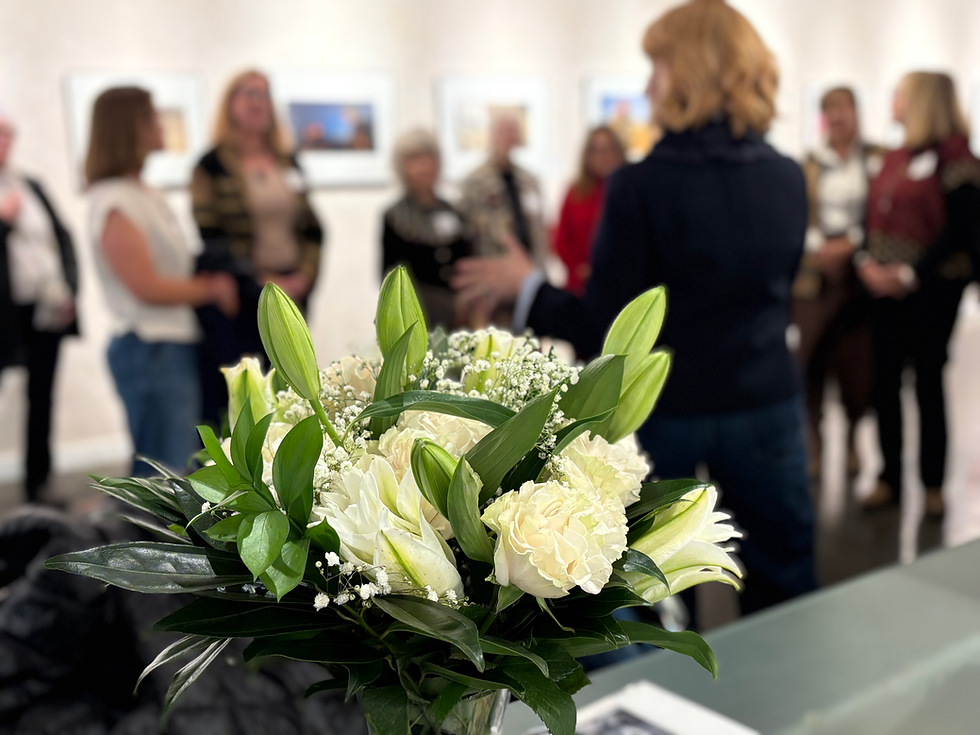
Recently, I attended a studio visit hosted by the New Mexico State Committee of the National Museum of Women in the Arts. As the artist talked about her abstract artwork, I realized that art is a little like brain scans (or probably any medical scan). To fully appreciate what you are seeing it is incredibly helpful to know more about who the artist is, their life story, their techniques, their intention, and their materials.
But why? Why can't we just look at a piece of artwork, see it on its own, without all that context, and get to the same level of appreciation?
Then I listened to The Telepathy Tapes podcast, and in the episode, they talked about how the human mind is designed to understand what is happening through storytelling. We need multiple data points to identify patterns and connect them in a coherent way. That connection - how this thing leads to that thing - is storytelling.
As I looked into this more, I realized this is not a new idea. For example, check out these quotes by people far more accomplished than I am - and dear reader, this is only the tip of the iceberg! There is so much more to learn about this topic. I encourage you to do your own research.
“Humans think in stories rather than in facts, numbers, or equations, and the simpler the story, the better.” — Yuval Noah Harari, historian, philosopher, and best-selling author
“We are, as a species, addicted to story. Even when the body goes to sleep, the mind stays up all night, telling itself stories.” — Jonathan Gottschall, Distinguished Fellow in the English Department at Washington & Jefferson College
“The human species thinks in metaphors and learns through stories.” — Mary Catherine Bateson, American writer and cultural anthropologist
“Humans are pattern-seeking story-telling animals, and we are quite adept at telling stories about patterns, whether they exist or not.” — Michael Shermer, American science writer and historian of science
Anyway, I realized that a piece of artwork is only one data point. Humans need more information, more data, to fully understand what we are seeing and experiencing, so we can write the story of that piece of art.
Thinking about all of this helped me understand the importance of telling the story behind each of my paintings.
Over the past few years, I've gone from being really excited to share everything about my art to feeling rather, well, nihilistic about it.
This shift mostly comes from the realization that art is completely subjective. And the business side of art is all business and no art - meaning art isn't appreciated for what it is, but instead for what it can be sold for. Add in the fact that women artists are still very undervalued and underrepresented, and it all feels rather bleak. Just check out these stats from the National Museum of Women in the Arts:
87% of the works in major museum collections are by men.
$5 billion is the pay gap between the top male and female artists.
Artworks by women account for only 39% of gallery sales.
There are a lot of reasons why women artists are not as successful as their male counterparts. To name just a few: centuries of systemic gender inequality, including restricted access to art education, exclusion from exhibitions, and fewer opportunities for patronage. There is a lot more, and I encourage you to read any of the books on gallery owner Tonya Turner Carroll's recommended reading list for more information: https://newmexicowomeninthearts.org/resource-library/art-resources/
My point is that finding success (which I define as regular sales of artwork priced to provide a living wage) as a woman artist in her 50s feels grim.
But there is always hope, and I think that for me, that hope comes in the form of telling the story of my art.
Thank you for being a reader of my blog, because this is one way that I'm getting my story out!
In the future, I plan to rewrite the copy on my website to be more engaging and provide more background information - more data points - so visitors can understand the full story. And I'm going to start practicing how I talk about my art so that when I'm face-to-face with someone, I can confidently and smoothly tell them the story.
But today I'm going to actually create art by going into the studio and painting!


I do all my social graphics in Canva but I stopped trying to fix photos in it. Clean the photo first with a dedicated shadow remover, then upload the clean version and do your layout. Trying to do both in one tool is why my templates used to look inconsistent - the photos were all lit differently and no amount of filter fixed it.